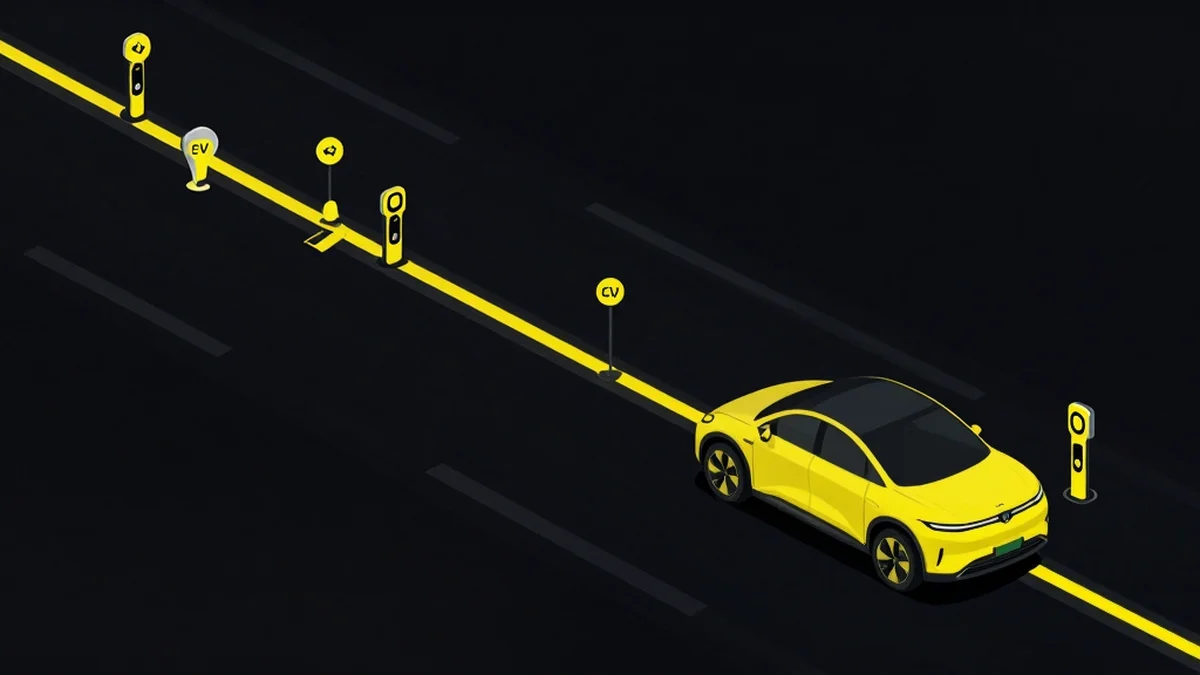
The key to a stress-free EV road trip is knowing your numbers before you leave. Start by entering your car in the Plan EV Charge calculator and setting the charger to a typical highway fast charger (150 kW or 250 kW CCS). Simulate charging from 10% to 80% to see your realistic charging time at each stop. For a car like the Tesla Model 3 Long Range at a 250 kW charger, that takes roughly 25 minutes. For a Renault Megane E-Tech at 130 kW, expect about 35 minutes.
Road Trip EV Charging: How to Plan Stops
Next, calculate your car's real-world highway consumption. Most EVs consume 15-25% more energy at sustained highway speeds (120-130 km/h) compared to the WLTP rated figure. A car rated at 16 kWh/100 km might actually use 19-20 kWh/100 km on the motorway. Divide your usable battery capacity by this highway consumption figure to get your realistic highway range. For a 75 kWh battery at 20 kWh/100 km, that is about 375 km of real-world range at 100% charge.
With these numbers, you can plan your stops. A typical strategy is to drive until you reach 10-15% SOC, charge to 80%, and repeat. Using the example above, each leg covers about 250-270 km (from 80% to 10%), and each charging stop takes 25-35 minutes. For a 800 km trip, that means 2-3 charging stops adding 50-90 minutes total to your journey.
The 80% Charging Strategy Explained
Charging from 10% to 80% is the sweet spot for road trip efficiency, and the reason is physics. DC fast charging speed depends heavily on the battery's state of charge. Below 80%, most EVs accept high charging power: a 150 kW-capable car might charge at 130-150 kW between 10% and 50%, then gradually taper to 80-100 kW between 50% and 80%. Above 80%, charging power drops dramatically, often to 30-50 kW, meaning the last 20% can take as long as the first 70%.
To see this in action, use the Plan EV Charge calculator to compare two scenarios for your car. First, simulate 10% to 80%: note the time and energy added. Then simulate 10% to 100%: the extra 20% often adds 20-30 minutes. On a road trip, those 20-30 minutes per stop add up quickly. It is almost always faster to make an additional short stop than to charge each stop to 100%.
The exception to the 80% rule is when you are on the last leg of your trip and need to arrive with a specific charge level. In that case, charging to 90% or even 100% at your final fast charging stop makes sense because you will not be stopping again. Also, on very cold days (below 0 degrees Celsius), charging speeds are reduced overall, so adjusting your target slightly higher (to 85%) can provide a useful buffer against increased consumption.
Finding Fast Chargers Along Your Route
Europe's fast charging network has grown rapidly, with over 150,000 DC fast charging points across the continent as of 2025. The major networks include Ionity (350 kW stations along European motorways), Tesla Superchargers (now open to non-Tesla EVs in most European countries), Fastned, Allego, and numerous national operators. Most motorway service areas in Western Europe now have at least one fast charging station.
The best route planning tools are A Better Route Planner (ABRP) and the built-in navigation in your EV. ABRP lets you input your car model, starting SOC, and destination, then automatically calculates optimal charging stops considering real-time charger availability, your car's charging curve, weather, elevation, and speed. It accounts for the fact that different chargers along your route may have different power levels and suggests stops that minimize total travel time.
Always have a backup plan. Check that there are alternative charging stations within a reasonable detour of your planned stops. Chargers can be occupied, out of order, or slower than expected. Having the Chargemap, Plugsurfing, or your car manufacturer's app installed gives you real-time availability data. For cross-border trips, verify that your charging cards or apps work in each country you are passing through, as network compatibility varies.
Time Management: Charge While You Rest
The smartest road trip strategy is to align charging stops with natural breaks. After 2-3 hours of driving, most people benefit from a 20-30 minute break for food, restrooms, or stretching. That is exactly the time needed to charge from 10% to 80% at a modern fast charger. Instead of viewing charging as wasted time, treat it as the break you would take anyway.
Plan your meal stops at locations with fast chargers. Many European motorway service areas now have 150-350 kW chargers alongside restaurants and shops. Arrive at the charger with 10-15% SOC, plug in, grab a meal, and return to a car charged to 80%. The charging adds zero net time to your break. For longer trips, consider timing one charging stop with lunch and another with a coffee break.
For families traveling with children, charging stops become welcome opportunities to let kids stretch and play. Some charging stations are located at rest areas with playgrounds or near shopping centers. The 20-30 minute charge time aligns well with a playground visit or snack break. Planning these stops as activity breaks rather than waiting periods completely changes the road trip experience.
Real-World Tips and Common Mistakes
The most common road trip mistake is overestimating range by relying on the car's displayed estimate at the start. The range displayed at 100% is calculated based on recent driving patterns, which may include city driving. On the motorway at 130 km/h with air conditioning running, real consumption can be 30-40% higher than the displayed estimate suggests. Always plan based on kWh consumption figures, not the dashboard range indicator.
Another frequent mistake is arriving at a charger with too little battery left. While 10% is the recommended arrival SOC, traffic, detours, or headwinds can consume more energy than expected. Aim to arrive at your planned charger with at least 10% remaining, and identify a backup charger within 20-30 km of each planned stop. Running an EV below 5% SOC accelerates battery degradation and risks being stranded.
Cold weather is the biggest range variable. At minus 10 degrees Celsius, expect 25-35% less range than in mild conditions due to battery heating, cabin heating, and reduced battery chemistry efficiency. Pre-condition your battery before fast charging by using the car's navigation to route to the charger, which triggers automatic battery preheating on most modern EVs. A warm battery charges significantly faster: the difference can be 30-50% faster charging speeds compared to a cold battery arriving at the station without preconditioning.