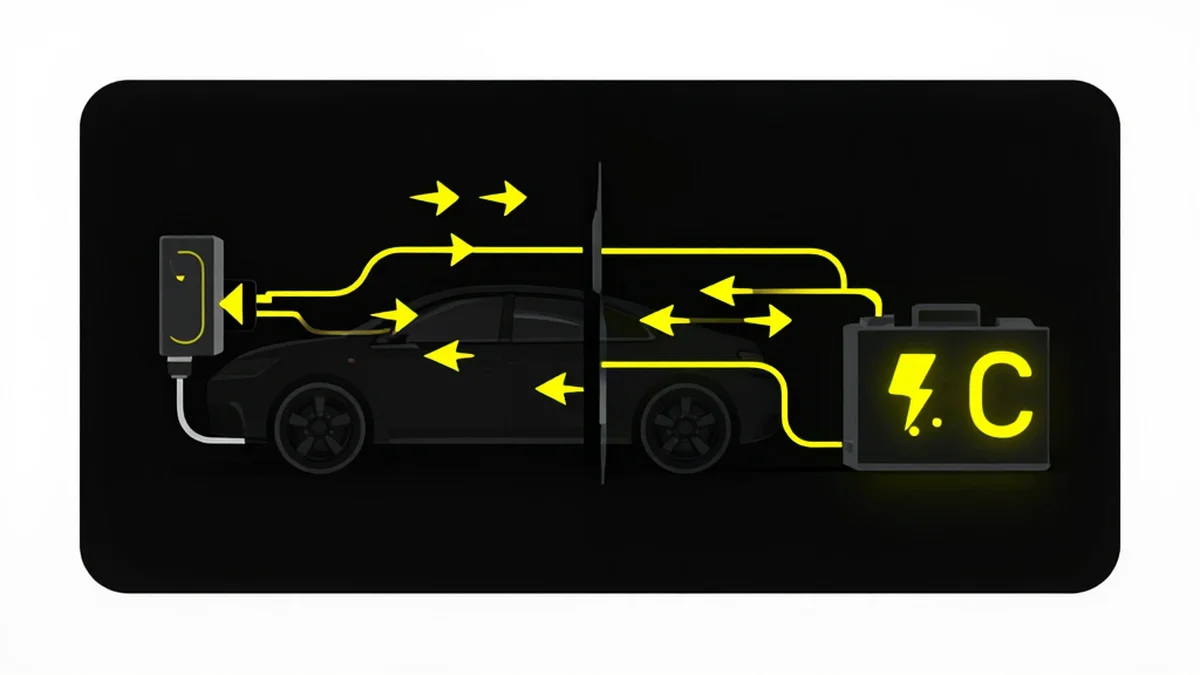
AC stands for alternating current, the type of electricity delivered by the power grid and every household socket in the world. DC stands for direct current, the type of electricity that batteries store and discharge. Every EV battery operates on DC, which means the grid's AC power must be converted before it can flow into the battery pack.
AC vs DC Charging Explained
This conversion is the key distinction between AC and DC charging stations. With AC charging, the conversion happens inside the vehicle. With DC charging, the conversion happens inside the station itself, before the electricity ever reaches the car. This seemingly small difference has enormous implications for charging speed and cost.
Understanding this distinction helps you make smarter decisions about which charger to use, how long your stop will take, and what infrastructure investments make sense for your home or business.
How the Onboard Charger Converts AC to DC
When you plug into an AC charging station or a home wallbox, alternating current flows through the cable and into your vehicle's onboard charger (OBC). This built-in component rectifies the AC power into DC and regulates voltage and current to safely charge the battery pack. The process generates some heat, which is why AC charging has roughly 92% efficiency, meaning about 8% of the energy drawn from the grid is lost.
The onboard charger's power rating is a hard limit on AC charging speed. Common ratings are 7.4 kW, 11 kW, and 22 kW. If you connect a car with a 7.4 kW OBC to a 22 kW AC station, the car will only draw 7.4 kW. The station is capable of more, but the vehicle's internal hardware cannot process it any faster.
This is why two different EVs at the same AC charger can have wildly different charging times. A Renault Zoe with its 22 kW OBC charges nearly three times faster on AC than a Volkswagen ID.3 limited to 7.4 kW on base models.
Why DC Charging Bypasses the Bottleneck
DC fast chargers contain large, powerful rectifiers that convert AC grid power to DC before it enters the vehicle. Because the conversion hardware sits in the station rather than the car, it can be much larger, heavier, and more powerful than any onboard charger. This is why DC stations can deliver 50 kW, 150 kW, or even 350 kW directly to the battery.
When you plug into a DC charger, the station communicates with the car's battery management system (BMS) to determine the optimal voltage and current at each moment. The BMS remains in control, requesting more or less power depending on battery temperature, state of charge, and cell health. The onboard charger is completely bypassed in this process.
DC charging achieves roughly 95% efficiency, slightly better than AC because there is only one conversion step rather than two (grid transformer plus onboard charger). However, DC stations are significantly more expensive to install and operate, which is reflected in higher per-kWh pricing at public networks.
Typical Power Levels: AC and DC Compared
AC charging spans four common power levels. A standard European household socket provides 2.3 kW (230V, 10A). A single-phase wallbox delivers up to 7.4 kW (230V, 32A). Three-phase connections unlock 11 kW (400V, 16A) and 22 kW (400V, 32A). In North America, Level 1 is 1.4 kW (120V) and Level 2 reaches up to 19.2 kW (240V, 80A), though most residential installations top out around 7.7 kW or 11.5 kW.
DC fast charging starts at 50 kW, the original CCS and CHAdeMO standard. Current mainstream deployments offer 150 kW, which can add roughly 150-200 km of range in 20 minutes. Premium networks from Tesla Supercharger V4, Ionity, and others now deploy 250-350 kW chargers. At 350 kW peak, compatible vehicles can gain 300 km of range in under 15 minutes.
The Plan EV Charge calculator automatically classifies any custom power value above 22 kW as DC charging and applies the appropriate efficiency factor and charging curve logic. This means you can model any charger, from a campsite outlet to the latest ultra-rapid station, and get accurate time and energy estimates.
When to Use AC vs DC Charging
AC charging is ideal for situations where your car will be parked for hours: at home overnight, at the office during work hours, or at a shopping center while you browse. It is cheaper per kWh, gentler on the battery, and the infrastructure cost is low. For most EV owners, a 7 kW home wallbox covers 90% of their charging needs.
DC charging is the right choice when time matters: road trips, quick top-ups during errands, or when you have no access to home or workplace charging. The convenience comes at a price premium, typically 0.40 to 0.80 EUR per kWh at public DC stations versus 0.15 to 0.30 EUR per kWh at home. Frequent DC fast charging can also accelerate battery degradation slightly over years of use, though modern BMS systems manage this well.
The smartest approach combines both. Charge at home or work on AC for daily needs and reserve DC fast charging for long trips or emergencies. Use the Plan EV Charge calculator to compare charging times and costs across different scenarios to find the mix that works for your routine.