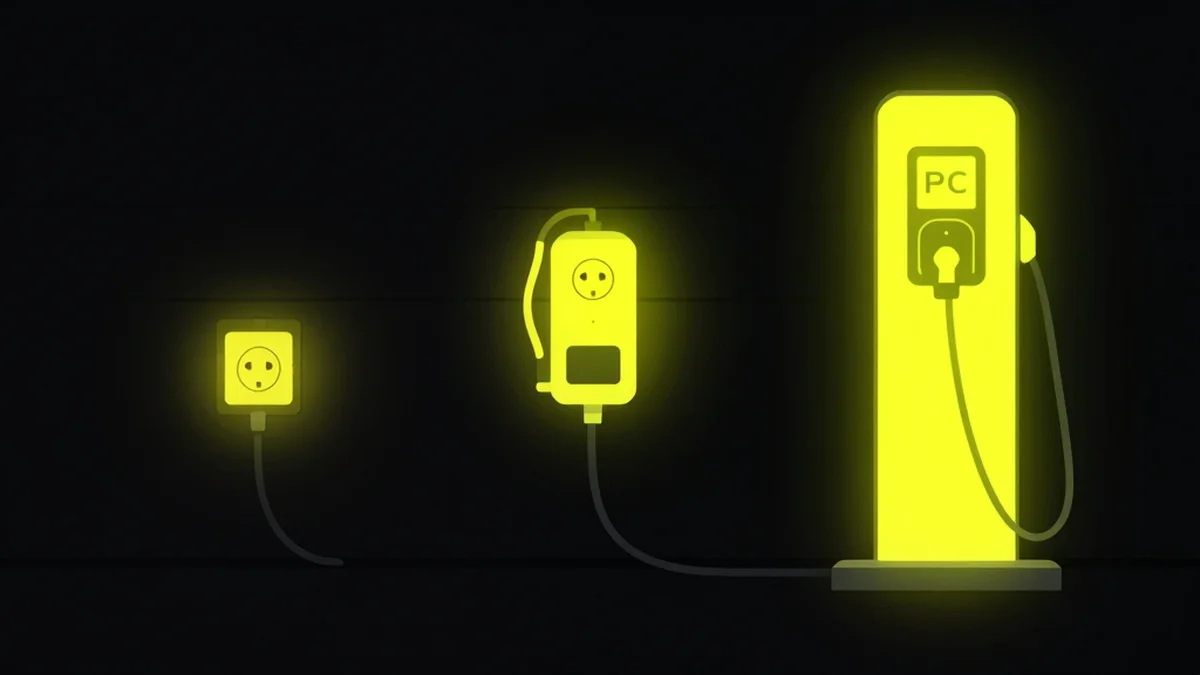
EV Charging GuideCharging Time & SpeedHome Outlet vs Wallbox vs Public Fast Charger
Home Outlet vs Wallbox vs Public Fast Charger
Compare the three main ways to charge an EV: household outlet, dedicated wallbox, and public fast charger. Understand the speed, cost, and convenience trade-offs of each option.
Try it with your car
Use our free calculator to simulate your exact charging time and cost.
The simplest way to charge an EV is plugging into a standard household socket using the portable EVSE cable that comes with most vehicles. In Europe, this delivers about 2.3 kW (230V at 10A). For a car with a 60 kWh battery, a full charge from empty takes roughly 26 hours. In practice, most people only need to replenish 30-50% of their battery overnight, which takes 8-13 hours.
Home Outlet vs Wallbox vs Public Fast Charger
The appeal of socket charging is zero installation cost. You plug in and it works. However, the circuit must be in good condition: a dedicated circuit with proper grounding is strongly recommended. Running an EV charge through an extension cord or a shared circuit with other appliances is a fire risk. Many electricians recommend a dedicated outlet inspection before relying on this method daily.
For drivers covering less than 40-50 km per day, a household socket can be sufficient. You add roughly 12-15 km of range per hour, so an 8-hour overnight session delivers 96-120 km. It is the cheapest option with the lowest upfront investment, making it a reasonable starting point for new EV owners unsure about their long-term needs.
Wallbox: 7-22 kW, the Home Charging Sweet Spot
A dedicated wallbox is the most popular home charging solution for good reason. A 7 kW single-phase unit charges a 60 kWh battery in about 8-9 hours, fitting perfectly into overnight schedules. Three-phase wallboxes at 11 kW bring that down to 5-6 hours, and 22 kW units can fully charge most EVs in 3-4 hours, though your car's onboard charger must support that rate.
Installation typically costs 500-1,500 EUR including the wallbox hardware, cabling, and electrician labor. Prices vary with cable run length and whether your electrical panel needs an upgrade. Many countries and municipalities offer subsidies covering 30-70% of this cost. A wallbox adds value to your property and is increasingly expected by home buyers.
Smart wallboxes offer scheduling, allowing you to charge during off-peak hours automatically. They can integrate with solar panels to use excess production, track energy consumption per session, and even load-balance across multiple EVs. The 7 kW option is the best value for most households, delivering enough speed for overnight charging without requiring a three-phase supply.
Public AC Chargers: 22 kW Destination Charging
Public AC chargers, typically rated at 7-22 kW, are found at supermarkets, parking garages, hotels, and workplaces. They serve the same role as a home wallbox but in public locations. A 22 kW public AC session can add 100-130 km of range per hour for cars with a 22 kW onboard charger, making them useful during a 2-3 hour shopping trip or restaurant visit.
Pricing varies significantly by network and location. Some are free (subsidized by the venue), others charge 0.25-0.45 EUR per kWh, and some add time-based fees after a certain duration to discourage overstaying. Apps like Chargemap, PlugShare, and individual network apps help you find available chargers and compare prices before you arrive.
Public AC is particularly valuable for apartment dwellers without home charging access. A regular twice-weekly session at a 22 kW charger near your office or gym can fully replace home charging. The key limitation is that if your car only supports 7.4 kW AC, you will charge three times slower than the station's rated speed, so always factor in your vehicle's onboard charger rating.
DC Fast Chargers: 50-350 kW for Quick Stops
DC fast chargers are the gas station equivalent for EVs. Found along highways and in urban hubs, they deliver 50 to 350 kW and can add 200-300 km of range in 15-30 minutes on compatible vehicles. They are essential for road trips and for drivers who need a quick top-up during a busy day.
The cost reflects the infrastructure: DC stations require high-power grid connections, expensive power electronics, and cooling systems. Public DC pricing ranges from 0.40 to 0.80 EUR per kWh, roughly 2-3 times the cost of home charging. Subscription plans from networks like Ionity, Fastned, or Tesla can reduce this to 0.30-0.50 EUR per kWh for frequent users.
DC charging also puts more stress on the battery than AC charging due to the higher power levels and heat generation. Modern EVs handle this well, but manufacturers generally recommend that DC fast charging should not be your only charging method. A mix of mostly AC charging at home or work, supplemented by DC on road trips, is the ideal balance for battery longevity and cost efficiency.
Comparison: Cost, Speed, and Convenience
Choosing between these options comes down to your daily driving distance, parking situation, and budget. A household socket costs nothing to install but adds only 12-15 km of range per hour. A wallbox costs 500-1,500 EUR upfront but delivers 40-130 km per hour and pays for itself in convenience within months. DC fast chargers require no personal investment but cost 2-3 times more per kWh.
For a typical EV owner driving 40 km per day, the annual energy cost is approximately 500-700 EUR at home rates (0.20-0.25 EUR/kWh with 92% AC efficiency) versus 1,200-1,800 EUR using only public DC (0.50-0.65 EUR/kWh with 95% DC efficiency). The wallbox installation pays for itself in under a year through charging cost savings alone.
The Plan EV Charge calculator lets you model all these scenarios. Enter your vehicle, select a charger type or set a custom power level, choose your start and target SOC, and instantly see the time and energy required. Compare a 2.3 kW overnight session against a 150 kW DC stop to understand the trade-offs for your specific vehicle and routine.