EV Charging GuideCharging Time & SpeedOvernight Charging: Will My EV Be Ready by Morning?
Overnight Charging: Will My EV Be Ready by Morning?
Find out how much range you can add overnight with different chargers, plus tips for maximizing your EV's morning readiness and saving money with off-peak rates.
Try it with your car
Use our free calculator to simulate your exact charging time and cost.
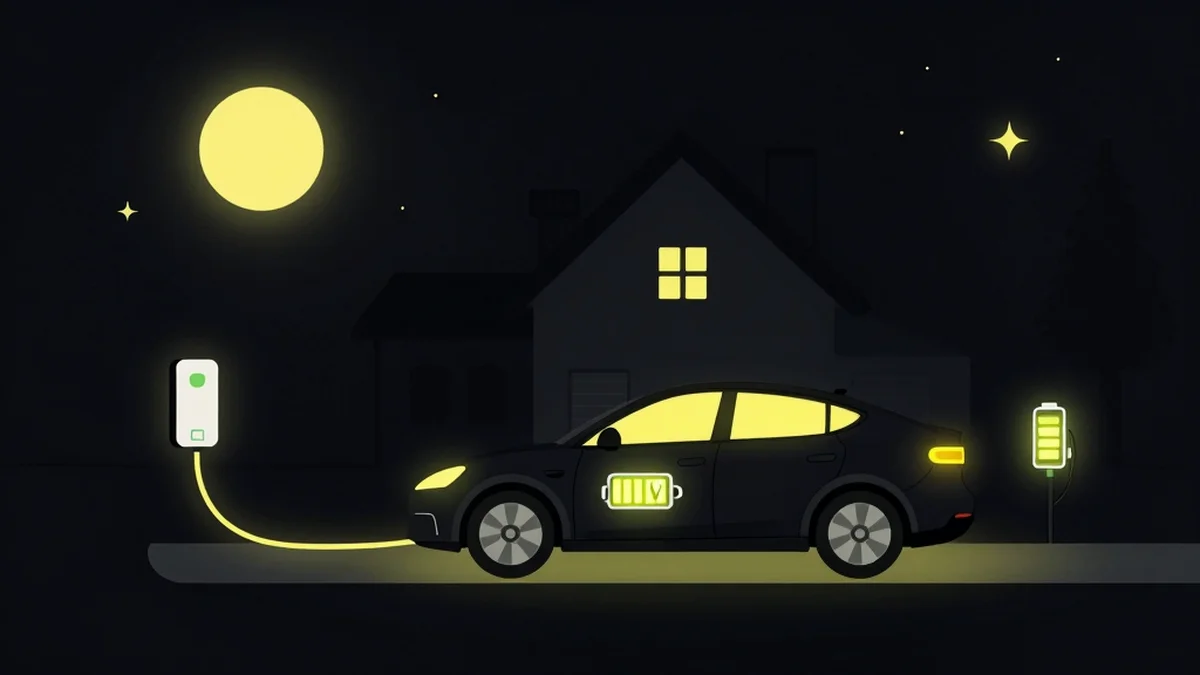
Most people have 8 to 10 hours between plugging in after dinner and leaving for work in the morning. This window is the sweet spot for home EV charging and, for most drivers, it is more than enough. An 8-hour session at just 2.3 kW from a household socket adds roughly 18 kWh, which translates to about 100-120 km of range depending on your vehicle's efficiency.
Overnight Charging: Will My EV Be Ready by Morning?
With a 7 kW wallbox, the same 8 hours delivers approximately 56 kWh. That is enough to fully charge the vast majority of EVs on the market, from a Fiat 500e with a 42 kWh battery to a Tesla Model 3 Long Range with 75 kWh usable capacity. Even a large-battery SUV like the BMW iX xDrive50 with its 105 kWh pack can recover 73% of its range in 8 hours at 7 kW.
If you have a three-phase connection and an 11 kW wallbox, 8 hours provides up to 88 kWh, enough to fully charge essentially any consumer EV from empty. At 22 kW, you could theoretically charge 176 kWh, but since no current passenger EV has a battery that large, an overnight session would complete well before morning.
How Much Range Can You Add Overnight?
The range added per hour depends on charger power and vehicle efficiency. A typical EV consumes 15-20 kWh per 100 km. At 2.3 kW, you add 12-15 km of range per hour, giving you 96-150 km over a 10-hour night. This covers the average European daily commute of 30-40 km with room to spare, but leaves you short if you had a particularly busy driving day.
At 7 kW, you add 35-47 km per hour, reaching 350-470 km over 10 hours. This effectively means you wake up to a full battery every single morning regardless of how much you drove the previous day. Even after a 300 km day trip, a 7 kW wallbox restores your full range overnight.
For larger batteries or heavier usage, 11 kW delivers 55-73 km per hour, or 550-730 km over 10 hours. Use the Plan EV Charge calculator to check your specific scenario: enter your car, select a 7 kW or 11 kW charger, set your expected evening SOC as the starting point, and target 80-90% to see exactly when your charge will complete.
Tips for Maximizing Overnight Charging
Set your vehicle's charge limit to 80-90% for daily use. This preserves battery health, reduces time spent in the slow upper SOC range, and still provides plenty of range for most routines. Only charge to 100% before a long trip, and time it so the car reaches full just before departure to minimize time spent at high SOC.
Use your car's or wallbox's built-in scheduler to start charging during off-peak hours, which typically begin between 22:00 and 00:00 depending on your electricity tariff. Some smart wallboxes can automatically optimize start time based on your departure schedule and tariff structure, ensuring the cheapest possible charge.
In cold climates, if your car supports it, schedule a departure time that triggers cabin preconditioning while still plugged in. This uses grid power instead of battery power to warm the cabin and battery, meaning you leave with more range and a preconditioned battery that is ready for efficient driving and, if needed, fast charging en route.
Saving Money with Off-Peak Electricity Rates
Many electricity providers offer time-of-use tariffs with significantly cheaper rates during overnight hours. In the EU, off-peak rates can be 30-50% lower than peak rates, dropping from 0.30-0.40 EUR/kWh during the day to 0.15-0.22 EUR/kWh at night. In some markets with dynamic pricing, overnight rates occasionally drop below 0.10 EUR/kWh or even go negative during high wind generation.
For an EV driven 15,000 km per year with an average consumption of 18 kWh/100 km, the annual charging cost at 0.30 EUR/kWh is about 810 EUR. Shifting all charging to off-peak at 0.18 EUR/kWh reduces this to 486 EUR, a saving of 324 EUR per year. Over a typical 8-year ownership period, that adds up to nearly 2,600 EUR, more than covering the cost of a wallbox and installation.
Some providers now offer EV-specific tariffs with a dedicated meter and ultra-low overnight rates. In the UK, tariffs like Octopus Go and Intelligent Octopus offer 0.075 GBP/kWh for overnight EV charging. Contact your energy provider to ask about EV-optimized tariffs, as switching can dramatically reduce your total cost of ownership.