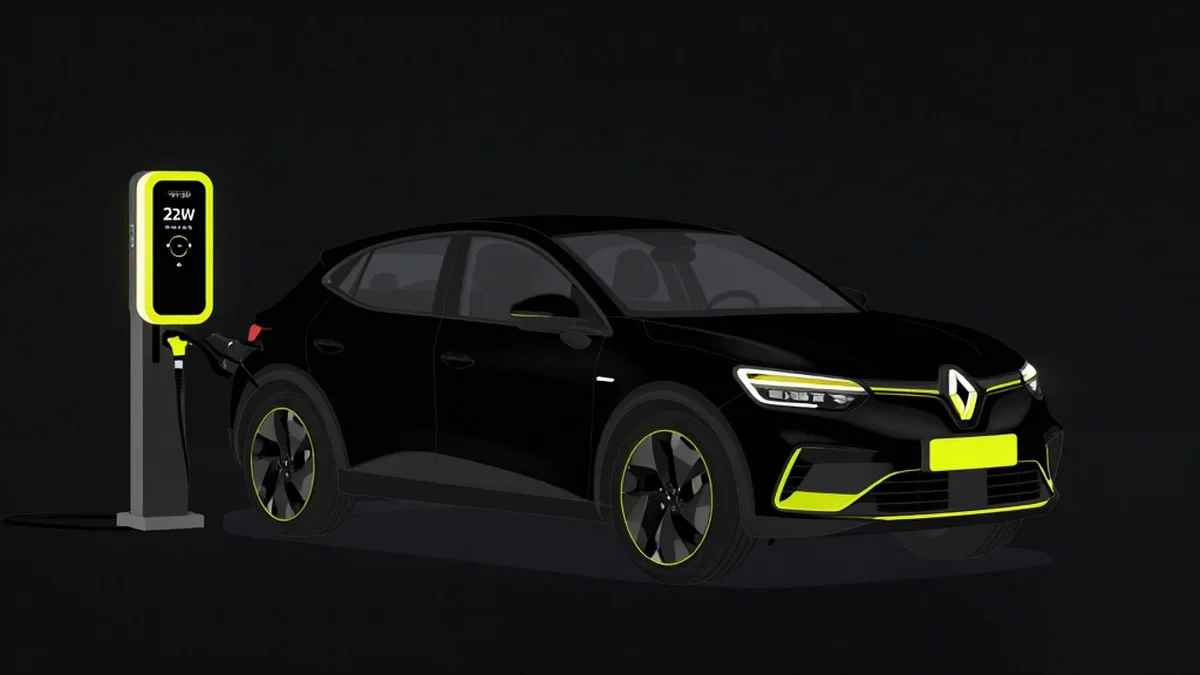
Complete charging guide for the Renault Megane E-Tech EV60 (60 kWh). Explore AC charging at up to 22 kW, DC fast charging curve details, and practical tips for maximizing efficiency.
🇫🇷
Renault Mégane E-Tech EV60
Usable battery
57 kWh
Max AC
22 kW
Max DC
127 kW
Consumption
16 kWh/100km
Try it with your car
Simulate charging time and cost for your Renault Mégane E-Tech EV60 now.
The Renault Megane E-Tech EV60 stands out in the compact electric hatchback segment with a 60 kWh gross battery (57 kWh usable) and a notably efficient consumption of approximately 16 kWh/100 km. This translates to a real-world range of around 356 km under typical conditions. A key differentiator is the 22 kW onboard AC charger — one of the highest in its class — combined with 127 kW DC fast charging capability.
Charging Guide Renault Megane
Renault's CMF-EV platform gives the Megane E-Tech a low, flat battery pack that contributes to both driving dynamics and efficient packaging. The 57 kWh usable capacity strikes a practical balance: large enough for comfortable daily range with weekend trip capability, yet small enough to charge quickly on both AC and DC. The car's efficient drivetrain means every kilowatt-hour goes further than in many competitors.
The 22 kW AC onboard charger is a genuine advantage for owners who have access to 22 kW public AC stations or who install a three-phase 22 kW wallbox at home. This effectively halves AC charging times compared to the 11 kW chargers found in most rivals, making the Megane E-Tech particularly well-suited to European charging infrastructure where 22 kW AC stations are common.
AC Charging Times: Home and Public Stations
On a standard 2.3 kW household outlet, the Renault Megane E-Tech EV60 charges from 10% to 80% in approximately 18 hours, with a full 10-100% charge taking around 23 hours. While this is slow, it's sufficient for overnight charging if your daily commute is under 80-100 km. The AC efficiency loss of about 8% means the wall draw is slightly higher than the energy reaching the battery.
The Megane E-Tech truly shines with its 22 kW onboard charger when paired with a compatible three-phase wallbox. A 10-80% charge takes just 2 hours, and a full 10-100% session completes in roughly 2.5 hours. This is nearly twice as fast as the 11 kW AC charging typical of competitors. Even a quick 2-hour stop at a 22 kW public AC charger can take you from near-empty to nearly full — a game-changer for destination charging.
At public AC stations offering only 11 kW, the Megane still charges at 11 kW (limited by the station, not the car). This takes about 4 hours for a 10-80% fill. However, at the many 22 kW public AC stations found across European cities, the Megane E-Tech leverages its full 22 kW capability. This makes it one of the most versatile EVs for mixed charging scenarios, reducing your dependence on DC fast chargers for day-to-day use.
DC Fast Charging: Curve and Performance
The Renault Megane E-Tech EV60 supports DC fast charging up to 127 kW. The charging curve ramps up steadily and reaches its peak of approximately 126 kW around 10% state of charge. This is a reasonably quick ramp, though not quite as instantaneous as some competitors. Once at peak power, the car delivers strong energy throughput in the 10-25% SOC range.
The taper begins after 25-30% SOC and is fairly progressive. By 50% SOC, charging power typically drops to around 80-90 kW, and it continues to decline as the battery fills. A complete 10-80% DC fast charge takes approximately 30-33 minutes under optimal temperature conditions. In the first 15 minutes of a fast charge, expect to add roughly 130-150 km of range.
Given the Megane's efficient 16 kWh/100 km consumption, even a quick 15-minute DC charge adds meaningful range. For road trips, the sweet spot is charging from 10% to 55-65%, which keeps you in the higher-power portion of the curve. The combination of strong DC capability and the 22 kW AC option gives Megane owners exceptional charging flexibility — use DC for quick highway stops and 22 kW AC for longer destination stops where speed still matters.
Real-World Charging Tips for the Renault Megane E-Tech
The Renault Megane E-Tech benefits from battery preconditioning when routing to a fast charger through the navigation system or the My Renault app. In winter, this can improve DC charging speeds by 15-20%, as the battery warms to its optimal 25-35 degree C range before arrival. Always program your destination charger through the car's nav to take advantage of this feature.
Maximize the Megane's unique 22 kW AC advantage by seeking out three-phase 22 kW stations for destination charging. In many European cities, 22 kW AC chargers are more widely available and less congested than DC fast chargers. A 2-hour lunch stop at a 22 kW charger can add over 300 km of range — nearly as practical as a quick DC stop but often cheaper and with less queue time. If installing a home wallbox, investing in a three-phase 22 kW unit fully exploits the Megane's onboard charger.
The Megane E-Tech's consumption is particularly sensitive to speed. At 90 km/h on secondary roads, consumption can drop to 13-14 kWh/100 km, yielding over 400 km of range. At 130 km/h on the autoroute, expect 18-20 kWh/100 km and around 290-310 km of range. In cold weather, consumption rises to 19-21 kWh/100 km. Using the ECO driving mode and the heat pump (standard equipment) helps maintain efficiency in winter, keeping range reduction to around 15-20% rather than the 30% seen in EVs without heat pumps.
Plan Your Renault Megane E-Tech Charges with Plan EV Charge
Plan EV Charge includes the Renault Megane E-Tech EV60 with its complete charging specifications, including the valuable 22 kW AC capability and detailed DC curve data. Select the Megane from the vehicle list and experiment with different charger power levels to see exactly how the 22 kW onboard charger transforms AC charging times.
One particularly useful comparison: simulate a charge session at 11 kW versus 22 kW AC to quantify the time savings. For a 20-80% session, the difference is dramatic — roughly 2.5 hours saved. This comparison alone can help justify the investment in a three-phase home wallbox or influence where you choose to charge publicly.
For road trips, the calculator models the Megane's specific DC taper curve, showing you exactly when charging power drops and where the diminishing returns kick in. Try comparing a single 10-80% stop against two shorter 10-50% stops to find your optimal strategy. The energy cost estimates help you compare DC fast charging prices against slower but cheaper 22 kW AC options along your route.