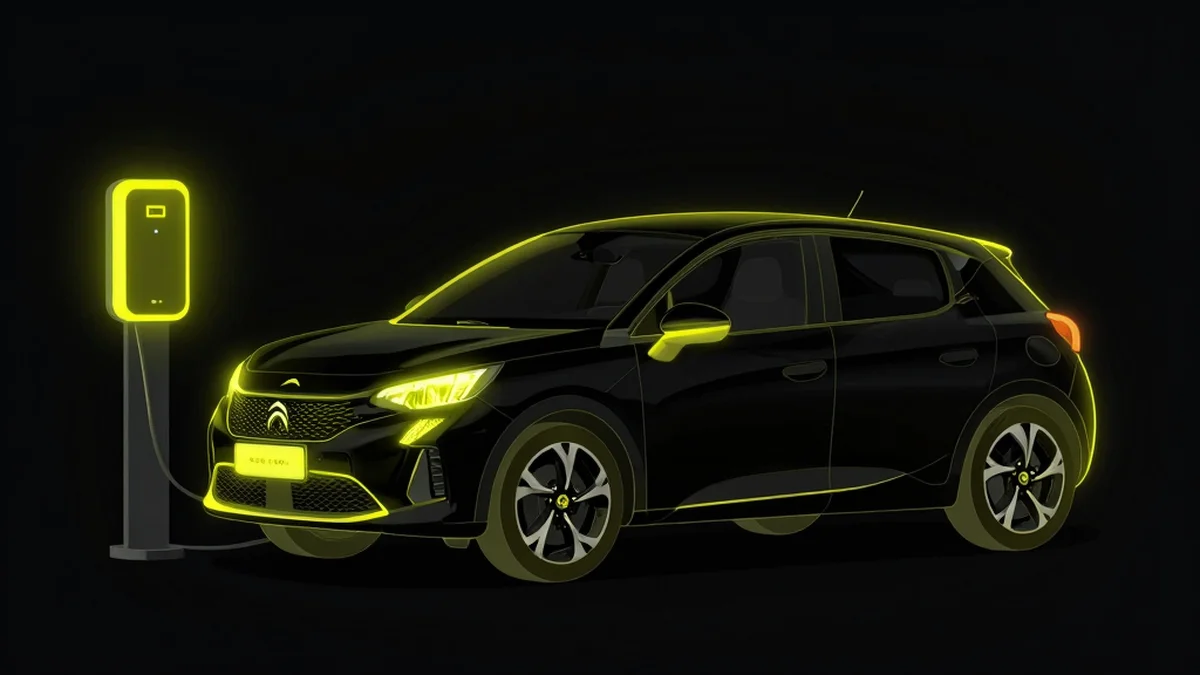
Complete charging guide for the popular Peugeot e-208 with its 51 kWh battery. AC and DC charging times, excellent mid-range charging curve analysis, and everyday tips.
🇫🇷
Peugeot e-208
Usable battery
48 kWh
Max AC
11 kW
Max DC
100 kW
Consumption
15.8 kWh/100km
Try it with your car
Simulate charging time and cost for your Peugeot e-208 now.
The Peugeot e-208 is one of the best-selling electric cars in France and across Europe, combining sharp styling with a well-balanced electric powertrain. Its 51 kWh gross (48 kWh usable) battery paired with a 15.8 kWh/100 km average consumption delivers approximately 304 km of real-world range — a sweet spot for compact car buyers.
Charging Guide Peugeot E208
The e-208 features an 11 kW onboard charger for AC, making it compatible with the full range of home and public AC chargers up to 11 kW. DC fast charging tops out at 100 kW, which is standard for its segment. Notably, the e-208's DC curve is one of the flattest in its class, holding high power across a wide SOC range.
As Peugeot's electric flagship in the B-segment, the e-208 has proven itself with hundreds of thousands of units on European roads. Its balance of range, charging capability, driving dynamics, and interior quality makes it the benchmark against which other compact EVs are measured.
AC Charging Times: Home Outlet & 11 kW Wallbox
From a 2.3 kW household outlet, charging the e-208's 48 kWh usable battery from 10-100% takes approximately 21 hours. For drivers covering 50-80 km daily, overnight outlet charging can work — a 12-hour overnight session adds about 28 kWh or 175 km of range. However, a wallbox is strongly recommended for a better daily experience.
With an 11 kW wallbox at home, a full 10-100% charge completes in about 4 hours 20 minutes. This is exceptionally convenient — plug in after work and the car is fully charged well before bedtime. Even 2 hours of charging adds roughly 22 kWh (about 140 km), more than enough to replenish a typical day's driving.
At public 22 kW AC stations, the e-208 charges at its 11 kW maximum. Parking at a shopping center for 2 hours adds about 22 kWh (140 km of range). The 11 kW rate makes public AC charging a viable option for regular top-ups, especially if you don't have home charging and rely on workplace or street-side chargers.
DC Fast Charging: A Remarkably Flat Curve
The Peugeot e-208's DC charging curve is one of its hidden strengths. It reaches 100 kW between 10-18% SOC, then holds remarkably steady between 80-98 kW all the way through 55% SOC. This flat curve means consistent, predictable charging sessions without the dramatic power drops seen in some competitors.
A 10-80% DC session takes approximately 28-32 minutes at a 100 kW charger. Thanks to the flat curve, the time per percentage point remains relatively consistent, unlike cars that charge quickly at low SOC but slow dramatically in the middle. A 10-50% top-up takes about 17-20 minutes and adds roughly 135 km of range — ideal for a quick motorway stop.
The flat curve also means there's less penalty for charging to higher SOC levels compared to cars with peaky curves. Going from 50% to 70% is still reasonably fast on the e-208, which gives you flexibility in planning road trip stops. At 50 kW chargers, a 10-80% session takes about 40-45 minutes — still practical for a lunch break.
Real-World Charging Tips for the Peugeot e-208
Install an 11 kW wallbox for the optimal home charging experience. The e-208's 4-hour full charge time means you can even do two full charges in a single overnight period if needed. If you're on single-phase power limited to 7 kW, the full charge still completes in about 7 hours — perfectly manageable overnight.
The e-208's flat DC curve means your road trip charging strategy can be more flexible than with many EVs. You don't need to religiously arrive at chargers below 15% — the difference between starting a DC session at 10% versus 25% is smaller than on cars with steep curves. This reduces range anxiety and lets you keep a more comfortable buffer.
For cost-conscious driving, the e-208's 15.8 kWh/100 km consumption means home charging costs about €7 per full charge at standard French rates. Use the three drive modes to manage consumption: Eco mode in the city can reduce consumption to under 14 kWh/100 km, extending range to 340+ km. On motorways at 130 km/h, expect consumption around 20-22 kWh/100 km and plan your stops accordingly.
Frequently Asked Questions
What is the maximum charging rate of the Peugeot e-208?
The Peugeot e-208 charges at a maximum of 11 kW AC and 100 kW DC. The DC peak is reached between 10 % and 18 % SOC and the curve stays remarkably flat at 80–98 kW through 55 % SOC. Public chargers above 100 kW give no extra speed; the car simply caps at 100 kW.
How long does the Peugeot e-208 take to charge?
On an 11 kW home wallbox, a full 10–100 % AC charge takes about 4 hours 20 minutes. A 10–80 % DC fast charge takes 28–32 minutes on a 100 kW charger, or about 40–45 minutes on a 50 kW charger. A 2.3 kW household outlet completes a full charge in around 21 hours.
Does the Peugeot e-208 support 11 kW or 22 kW AC charging?
The e-208's onboard charger accepts 11 kW AC maximum — there is no 22 kW option. A 22 kW public station charges no faster than an 11 kW one; the car draws 11 kW in both cases. An 11 kW home wallbox is the right match for daily charging.
How long does the Peugeot e-208 take to charge from 10 to 80 %?
About 28–32 minutes on a 100 kW DC charger in good conditions. The flat 80–98 kW plateau through 55 % SOC means the time per percentage point stays consistent rather than dropping off sharply mid-session. A 10–50 % top-up takes about 17–20 minutes and adds ~135 km of range.
Why is the Peugeot e-208's flat charging curve a benefit?
A flat curve means the car charges at near-peak power for a longer SOC window rather than dropping off quickly after 30 %. In practice you get more consistent session times and less penalty for charging higher: going from 50 % to 70 % is still reasonably fast on the e-208, which is unusual for a car at this peak power level. It also reduces road-trip planning anxiety — you don't have to arrive at chargers below 15 % to get full performance.
How do I plan road trip charging stops for a Peugeot e-208?
With ~304 km of real-world range — closer to 220–240 km on the motorway at 130 km/h — plan a stop every 180–220 km. Aim to arrive at fast chargers around 15–20 % SOC and charge to 70–80 %. The flat curve means the e-208 keeps adding range steadily across the session; the Plan EV Charge calculator includes the e-208's real curve and helps compare a single longer stop against two shorter ones.
Simulate Your e-208 Charging Sessions with Plan EV Charge
Plan EV Charge includes the Peugeot e-208's actual DC curve with its characteristically flat profile, giving you accurate session times that reflect this car's real-world strength. Select the e-208 in the calculator and compare charging from different starting SOC levels to see how the flat curve affects your stop duration.
The calculator is perfect for comparing the e-208 against other compact EVs you might be considering. Run the same charging scenario — say, 15-80% at a 100 kW charger — on the e-208 and a competitor to see how the curves translate into real time differences. The e-208's flat curve often delivers better real-world times than its peak power number suggests.
Plan your road trips with confidence by saving charging sessions to your charge plan. The e-208's predictable charging behavior makes it easy to plan accurate schedules. Whether you're heading to the Mediterranean or crossing into Belgium, Plan EV Charge gives you a realistic picture of your journey based on the e-208's proven charging performance.