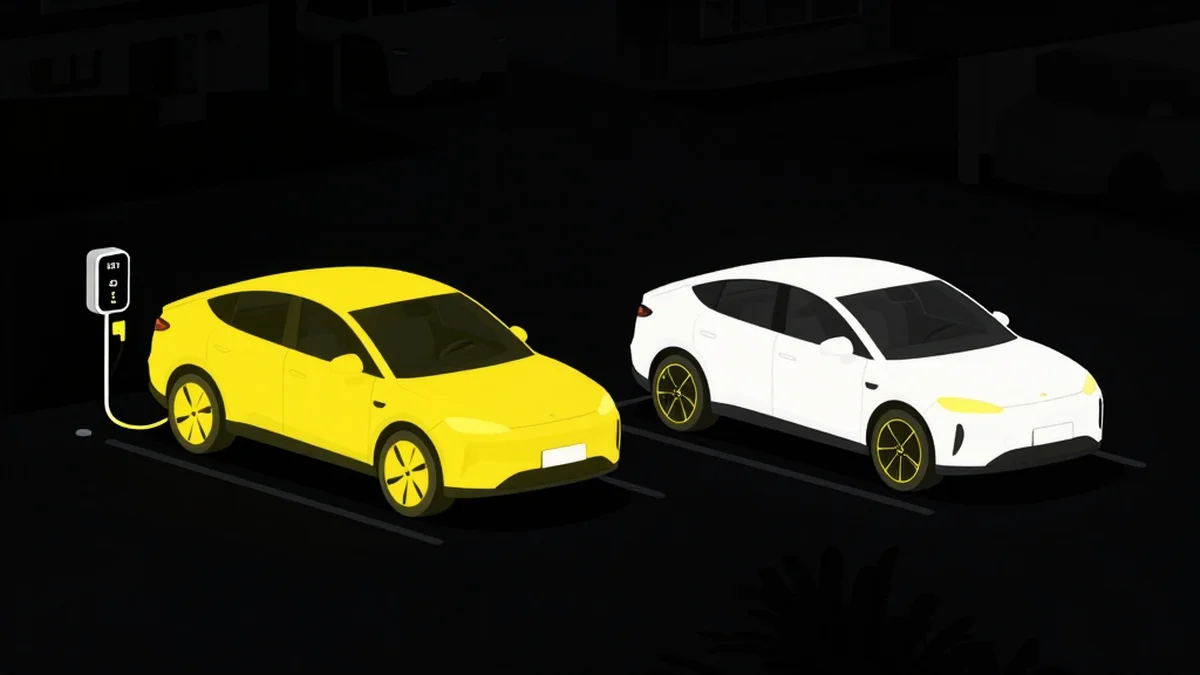
Electrical Capacity: Can Your Home Handle Two EVs?
The first concern with two EVs is whether your home's electrical supply can handle the combined charging load. A typical European home has a main supply of 12-36 kW depending on the country and connection type. Two wallboxes charging simultaneously at 7.4 kW each draw 14.8 kW, which already consumes a significant portion of a standard single-phase 9.2 kW supply. For homes with single-phase power, simultaneous dual EV charging at full speed may not be possible without a supply upgrade.
Two EVs in One Household: Managing the Charging
Three-phase connections, common in many European countries, provide more headroom. A typical three-phase supply rated at 3x25A delivers about 17.3 kW total. With load management, two EVs can share this capacity intelligently: when one car needs more power, the other reduces automatically. Some wallbox manufacturers like Easee, Zaptec, and Wallbox offer built-in multi-unit load balancing that distributes available power across two or more chargers without exceeding the main breaker limit.
Before installing a second charger, consult an electrician to measure your actual peak household demand. If your home typically draws 3-5 kW for appliances, lighting, and cooking, and you have a 12 kW single-phase supply, you only have 7-9 kW available for EV charging. That might mean two chargers at 3.7 kW each, or one at 7.4 kW with the other waiting. Use the Plan EV Charge calculator to verify that 3.7 kW still meets each car's overnight charging needs.
Scheduling Strategies: Stagger Your Charging
The simplest solution for two EVs with limited electrical capacity is staggered charging. Program one car to charge from 10 PM to 2 AM and the other from 2 AM to 6 AM. With a 7.4 kW charger, 4 hours delivers about 28 kWh, enough to cover a 150 km daily commute for most EVs. This approach requires no additional hardware beyond a smart wallbox with scheduling capability or using each car's built-in charge timer.
Priority-based scheduling is another effective strategy. Designate the car with the longer daily commute or larger battery as the primary charger, giving it first access at full power during off-peak hours. The second car, typically used for shorter trips, charges on the remaining time or at reduced power. Most smart wallboxes allow you to set priority rules, so the system handles this automatically once configured.
Weekend catch-up charging can supplement weekday sessions. If weekday charging windows are tight, use the weekend to bring both batteries up to 80%. With all day available and lower household electrical demand, both cars can charge comfortably even on a limited supply. This works especially well when one car is mainly a weekend vehicle used for errands and family trips.
Cost Tracking Per Vehicle
When two EVs share one household electricity bill, tracking per-vehicle charging costs becomes important for budgeting and, in some cases, for employer reimbursement. Smart wallboxes with built-in energy meters provide the most accurate tracking. Each wallbox logs the kWh delivered per charging session, and the companion app typically shows daily, weekly, and monthly energy consumption with cost calculations based on your electricity rate.
If you use a single wallbox shared between two cars, RFID-based user identification can distinguish between vehicles. Each driver taps a personal RFID card or uses their phone to authenticate before charging, and the wallbox attributes the energy consumption to the correct user. This data can be exported for expense reports or employer reimbursement claims.
For a rough cost comparison, enter each car's specifications into the Plan EV Charge calculator with your home charger power and electricity rate. The calculator shows the cost per charge session for each vehicle. A smaller city EV consuming 14 kWh/100 km costs roughly 4.20 euros per 100 km at 0.30 euros/kWh, while a larger SUV consuming 22 kWh/100 km costs 6.60 euros per 100 km. Knowing these per-vehicle costs helps allocate the household charging budget fairly.
Smart Home Integration for Multi-EV Households
A smart home energy management system (HEMS) is the most elegant solution for households with two EVs. Systems like Home Assistant, combined with compatible wallboxes and a main panel energy meter, can orchestrate charging across both vehicles while respecting the home's total electrical capacity. The HEMS monitors real-time household consumption and dynamically allocates surplus power to whichever car needs it most.
Solar panel integration adds another dimension. A HEMS can prioritize EV charging when solar production exceeds household consumption, effectively charging your cars for free with excess solar energy. In a typical European household with a 6-10 kWp solar installation, midday solar surplus can deliver 3-6 kW to an EV for several hours. Over a year, this can provide 2,000-4,000 kWh of free charging, worth 600-1,200 euros at average electricity rates.
The most advanced setups use dynamic electricity tariffs (like Tibber, Octopus Energy, or aWATTar) combined with HEMS automation to charge both cars during the absolute cheapest hours. The system checks hourly electricity prices, weather forecasts for solar production, and each car's scheduled departure time, then calculates the optimal charging schedule. This approach can reduce charging costs by 30-50% compared to flat-rate charging, easily saving 500 euros or more per year for a two-EV household.