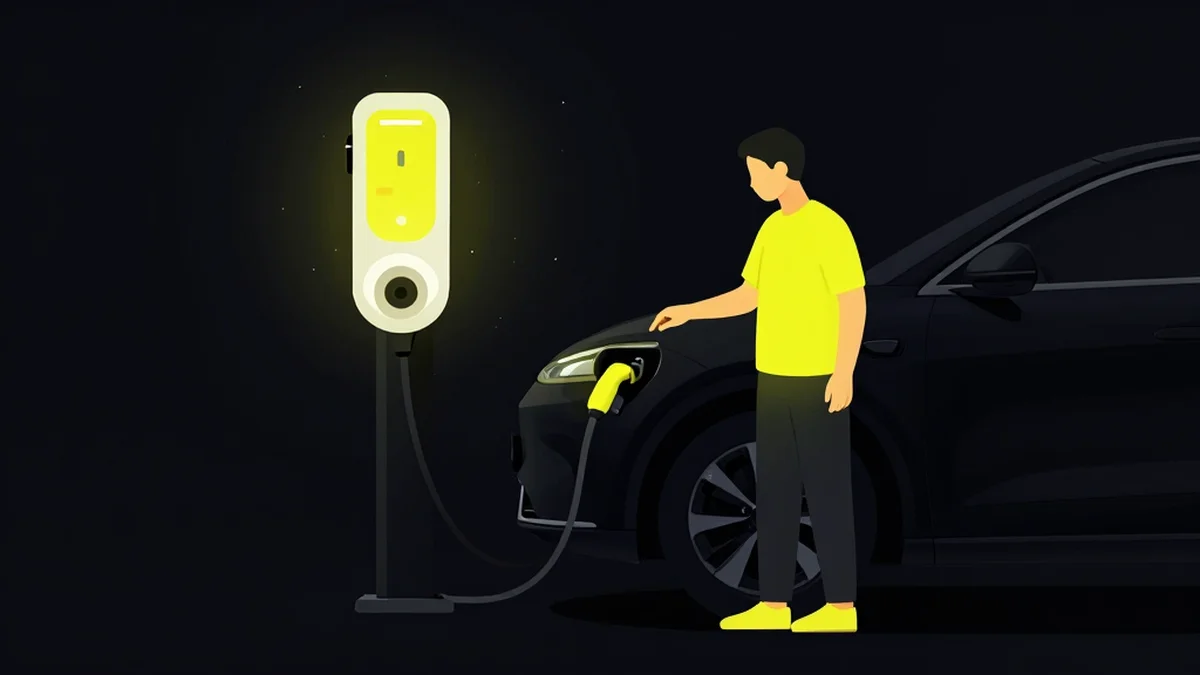
In Europe, you only need to know two connector types. Type 2 (also called Mennekes) is the standard AC charging connector used at home wallboxes, workplace chargers, and public AC stations. Every EV sold in Europe has a Type 2 inlet. It handles power levels from 3.7 kW (single-phase) up to 43 kW (three-phase), though most cars accept up to 11 kW or 22 kW AC. The connector has a distinctive flat top edge and seven pins.
First-Time EV Owner: Charging Guide for Beginners
CCS (Combined Charging System), specifically CCS2 in Europe, is used for DC fast charging. It is essentially a Type 2 connector with two additional DC power pins below, allowing the same inlet on your car to accept both AC and DC charging. CCS2 handles power levels from 50 kW up to 350 kW. When you pull up to a DC fast charger, the station has a permanently attached CCS cable that you plug directly into your car.
There are a few exceptions to know about. Tesla vehicles in Europe use the CCS2 standard, so they are compatible with all European chargers. Older Nissan Leaf models and some Mitsubishi PHEVs use CHAdeMO for DC fast charging, but this standard is being phased out in Europe. If you are buying a new EV today, it will have Type 2 and CCS2, and you will be compatible with virtually every charger on the continent.
Where to Charge: Home, Work, and Public Options
Home charging is the most convenient and cheapest option, covering 70-80% of charging needs for most EV owners. Plugging in when you arrive home and unplugging when you leave is simpler than refueling at a petrol station. Even a basic 7.4 kW wallbox fully charges most EVs overnight. At an average European residential rate of 0.25-0.35 euros/kWh, a full charge costs 15-25 euros and provides 300-500 km of range.
Workplace charging is the second best option, especially if your employer offers free or subsidized charging. An 8-hour workday on a 7.4 kW charger adds about 55 kWh, more than enough to offset your daily commute and then some. If you live in an apartment without home charging, workplace charging can become your primary charging solution.
Public charging fills the gaps. AC public chargers (7-22 kW) at supermarkets, shopping centers, and parking garages are perfect for opportunity charging while you run errands. DC fast chargers (50-350 kW) along motorways and at dedicated charging hubs handle long-distance travel and emergency top-ups. Public charging costs more (0.40-0.79 euros/kWh) but is rarely your primary charging source. Use the Plan EV Charge calculator to compare costs at different charging speeds and prices to find the best mix for your situation.
Charging Apps and Networks You Need
As a new EV owner, install three to four charging apps to ensure you always have access to a charger. Start with your car manufacturer's app (Tesla, MyBMW, Volkswagen WeConnect, etc.), which typically includes a built-in charging map and may offer preferential rates on partner networks. Add a roaming provider like Plugsurfing, Chargemap, or Shell Recharge, which gives you access to thousands of chargers across multiple networks with a single account and RFID card.
For route planning and charger finding, A Better Route Planner (ABRP) is essential. It knows your car's exact charging curve and consumption, plans optimal stops for road trips, and shows real-time charger availability. Chargemap is another excellent resource with user-contributed reviews and photos of charging stations, helping you avoid broken or hard-to-find chargers.
Pricing varies significantly between networks and access methods. Charging directly with the network operator's app is usually cheapest. Roaming providers add a markup of 0.05-0.15 euros/kWh for the convenience of cross-network access. Some networks require a monthly subscription (5-13 euros/month) that unlocks lower per-kWh rates. For occasional public charging, pay-as-you-go with a roaming provider is simplest. If you charge publicly more than twice a week, a subscription to your most-used network typically pays for itself.
Setting Up Home Charging
Setting up home charging is the single best investment you can make as a new EV owner. Start by determining your electrical situation: check your main breaker rating (marked on the breaker in your electrical panel) and whether you have single-phase or three-phase power. In most of Western Europe, you can find this on your electricity contract or by calling your energy provider.
For most households, a 7.4 kW single-phase wallbox is the sweet spot. It charges a typical EV from 20% to 80% in 5-6 hours, comfortably fitting within an overnight window. Get quotes from two or three certified electricians, ideally ones experienced with EV charger installations. The total cost (wallbox plus installation) typically runs 800-1,500 euros before any government subsidies. Check for available grants in your country before purchasing.
Once installed, configure your wallbox or car's charging schedule to take advantage of off-peak electricity rates if available. Set a default charge limit of 80% for daily use to maximize battery longevity. Test the setup by running a full charge cycle and verifying the energy consumption matches what the Plan EV Charge calculator predicts. If the actual charging time is significantly longer than calculated, there may be an issue with the installation or the car's onboard charger settings that needs attention.
Common Beginner Mistakes to Avoid
The number one beginner mistake is charging to 100% every day. Unlike a petrol tank, a lithium-ion battery degrades faster when kept at very high or very low charge levels. Set your daily charge limit to 80% and only charge to 100% before long trips. Most EVs let you set this limit in the car's settings or through the manufacturer's app. This simple habit can extend your battery's lifespan by several years.
Another common mistake is relying exclusively on DC fast charging. While convenient, frequent fast charging generates more heat in the battery, which accelerates wear over time. Most manufacturers recommend that DC fast charging should make up no more than 20-30% of your total charging. Home or workplace AC charging at 7-22 kW is gentler on the battery and significantly cheaper. Fast charging is best reserved for road trips and emergencies.
New EV owners often underestimate how weather affects range. In winter, expect 20-30% less range than the car's rated figure due to heating the cabin and battery, increased rolling resistance from cold tires, and reduced battery chemistry efficiency. Do not panic when your range drops in December. Plan for it by keeping the battery above 20% in cold weather and pre-conditioning the cabin while the car is still plugged in, which uses grid power instead of battery power for initial heating.